Bugatti W16 Mistral : Bugatti W16 Mistral is more than just another hypercar; it is the final, open‑top farewell to one of the most outrageous engines the world has ever seen.
With just 99 cars built and a record for being the fastest roadster on the planet, it closes the W16 chapter with a mix of brutal performance and exquisite craftsmanship.
Last Of The Legendary W16
When Bugatti unveiled the W16 Mistral at Monterey Car Week in 2022, it was clear this car had a very specific mission: to give the quad‑turbo 8.0‑litre W16 a dramatic send‑off.
Since the Veyron in the mid‑2000s, this engine has defined Bugatti, evolving through the Chiron and its special editions before finally bowing out in the Mistral.
The car’s limited production run and immediate sell‑out status underline how collectors instantly recognised it as the last chance to own a brand‑new, road‑going Bugatti with this iconic powertrain.
World’s Fastest Roadster
The numbers behind the W16 Mistral read like engineering fantasy: around 1,600 PS (1,578 hp), 1,600 Nm of torque and a top speed claimed at more than 420 km/h.
In November 2024, Bugatti confirmed that the Mistral had set a new benchmark for open‑top cars with a top‑speed run of 453.91 km/h, officially making it the fastest roadster in the world.
From a standstill, it can blast from 0 to 100 km/h in about 2.4 seconds, compressing the kind of acceleration you might expect from a race car into something that wears number plates.
Design: Wind As Inspiration
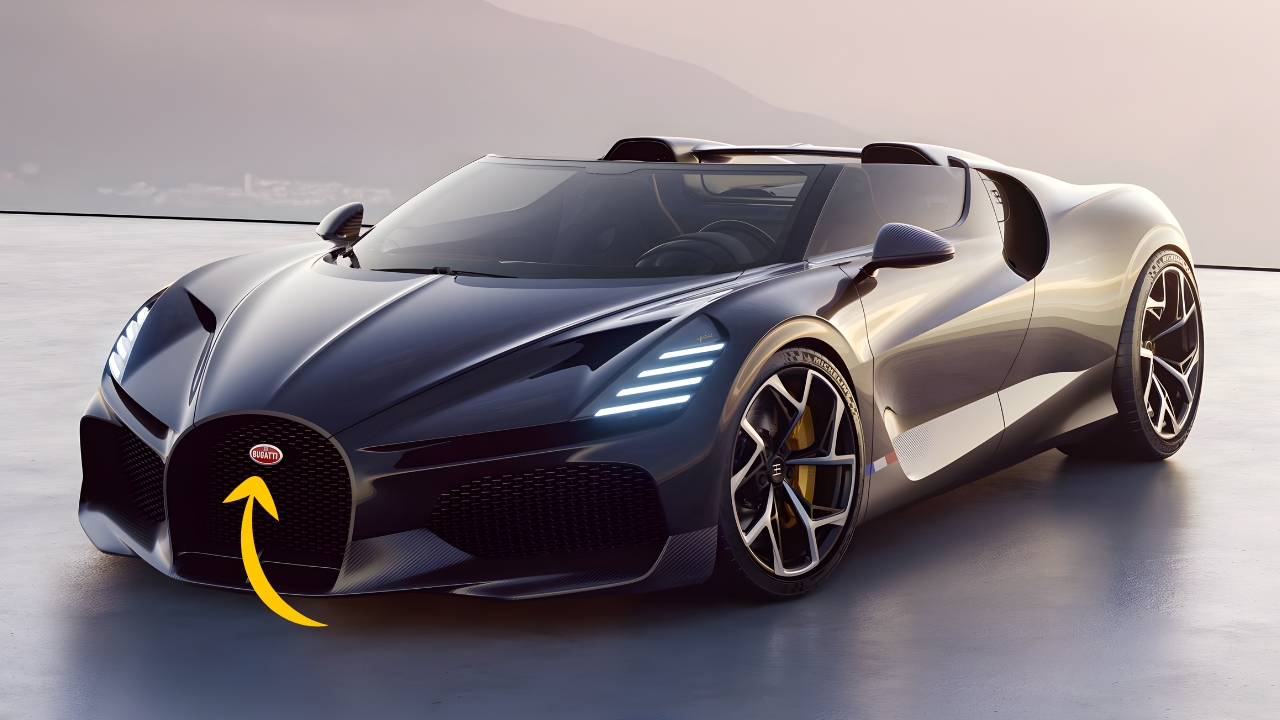
Bugatti named the car after the Mistral, a powerful wind that blows through the Rhône Valley in France, and the design is full of references to airflow and movement.
Unlike the Chiron, the Mistral is a bespoke roadster, not just a chopped‑roof version, with a completely reworked body that balances drag reduction and downforce at extreme speeds.
Its headlights, for example, are shaped to act as aerodynamic channels, guiding high‑pressure air around the front and out through the wheel arches to cut turbulence.
Aerodynamics At 400 km/h And Beyond
Achieving more than 420 km/h in an open‑top car is a huge challenge, and Bugatti’s engineers spent considerable effort on thermodynamics and aerodynamics.
The wider horseshoe grille is designed to feed the main radiator alone, leaving the side intakes to focus purely on cooling the intercoolers and other components.
A carefully profiled windscreen, underbody, front splitter and deployable rear wing together create a stable “aero map” that keeps the car planted and predictable even at speeds where most aircraft are already rotating for take‑off.
Interior: Chiron Roots, Mistral Details
Inside, the W16 Mistral takes the Chiron’s cockpit as a starting point but refines it into something even more focused on open‑air driving.
The layout keeps all critical information clearly readable at over 400 km/h, with analogue‑inspired dials and digital displays blended to avoid distraction.
Materials are pure Bugatti: advanced composites, milled aluminium switchgear, titanium components and soft, near‑flawless leather that is hand‑finished to a level more associated with haute couture than automotive manufacturing.
Deliveries And Global Presence
Customer deliveries began in 2024 and accelerated through 2025, with the first production cars heading to ultra‑wealthy buyers in the United States and other key markets.
Many of these cars are specified through Bugatti’s Sur Mesure programme, resulting in one‑off paint schemes and detailing that reference historic Bugatti racers or personal stories of the owners.
By 2026, sightings of the W16 Mistral in hypercar hotspots like Dubai, Monaco and Singapore have turned it into a rolling symbol of the end of the combustion‑era Bugatti.
Also Read This : Toyota Fortuner Leader Edition Full loaded features premium SUV, engine is high power
Bugatti W16 Mistral End Of An Era, Start Of Another
Although the W16 Mistral celebrates the past, it also acts as a bridge to Bugatti’s future, which moves towards a new V16‑hybrid era with the upcoming Tourbillon.
Once the final 99 Mistrals are delivered, the quad‑turbo W16 that began life in the Veyron will officially retire from series‑production road cars, ending a two‑decade run that reset the boundaries of performance.
For enthusiasts, the Mistral is likely to go down as the definitive open‑air expression of that era: a roadster where the full drama of the W16 is unleashed straight into the sky above the driver’s head.